
How We Helped Kiavi Increase Year-over-Year AI Citations by 1,832.87% and Organic Traffic by 17.4% in 4 Months
CASE STUDIES
Agnes A. Gaddis
11 min read
CASE STUDY
How We Helped Kiavi Increase
Year-over-Year AEO Citations by 1,832.87%
and Organic Traffic by 17.4% in 4 Months
+1,832.87%
YoY AEO Visibility
+17.4%
YoY Organic Traffic
16 wks
Time to Results
+1,832.87% YoY increase in Google AI Overviews visibility.
+17.4% YoY organic traffic growth at a time when most websites are experiencing strict declines.
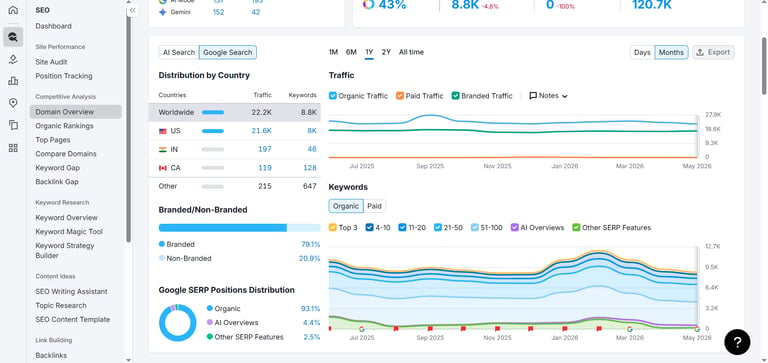
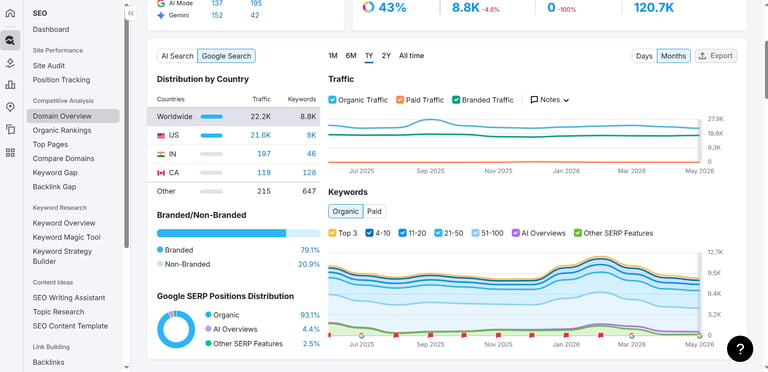
27,945 sessions in Month 1 (September) — Kiavi’s highest-traffic month on record, according to Semrush.
Traffic diversification achieved through systematic content repurposing into 12 social pieces per blog post.
“We’ve been working with Agnes for several months now, and she has been a fantastic addition to our content process. Her expertise in content writing and SEO consulting has made her invaluable to us. She consistently delivers high-quality, well-researched, human-written content that performs exceptionally well. In addition, we’ve been working with Agnes to develop GEO content, which has led to a noticeable increase in our AI visibility (+1,832.87% YOY). We’ve also experienced an increase in organic traffic (+17.4% YOY) at a time when many websites are seeing strict declines in this area. Can’t imagine how we’d produce this much in-depth content without her. Highly recommend.”
— Angela Davis, Brand and Content Marketing Manager, Kiavi
At-a-glance results
Introduction: The industry landscape & the core problem
A few years ago, dominating page one of Google was the whole game. If you published consistently and provided a solid user experience, you were sure to see a steady growth in traffic and clicks over time. For companies like Kiavi — the undisputed big dog in residential real estate lending, this playbook worked well. But as of 2025/2026, it no longer does. Why?
AI tools like ChatGPT and Google's AI Overviews now give users direct answers. If these AI systems don't cite your brand, you literally become invisible on those platforms.
Traditional SEO rankings no longer guarantee traffic or clicks because almost 60% of searches now end on Google — zero-click. Google's AI Overviews now answer queries directly at the top of the SERPs. For millions of users, platforms like Claude, ChatGPT, and Gemini have largely replaced Google Search for most informational queries.
While this seems like the end of search as we know it, it's a new frontier where the brands cited by AI systems capture intent-driven traffic and the brands that don't get cited remain invisible, regardless of their page 1 SEO rankings.
Brands that want to stay visible in 2026 and beyond have to adopt a new playbook: AEO (Answer Engine Optimization). This is part of a broader term called GEO (Generative Engine Optimization). And it is exactly what BoldREcontent helped Kiavi with.
Through a combination of human-first content creation, E-E-A-T, and AI visibility optimization, we helped Kiavi achieve a +1,832.87% YoY increase in AI Overviews visibility and +17.4% YoY organic traffic growth in just 16 weeks. Here is exactly how we did it.
The client
Kiavi is one of the most recognized names in real estate investment financing. They rebranded from LendingHome to Kiavi in 2021 to spotlight their focus on tech-enabled real estate lending. Kiavi specializes in short-term bridge loans, DSCR loans, and fix-and flip loans to residential real estate investors.
They essentially dominated the niche with SEO, beating competitors like LendingOne, Easy Street Capital, and LimaOne when it came to organic traffic. They were doing everything right by publishing consistently and offering a really great user experience.
Yet their organic traffic had stagnated, and consistent publishing was no longer moving the needle. Here were the two major problems we detected. The first one was what they came to us for:
Problem 1: Over-reliance on AI-generated content
Kiavi had been producing predominantly AI-generated content. They identified that they were "seeing adverse effects" from this approach. The content was too "thin" and just matched patterns, so it wasn't actually building any real authority with knowledgeable readers or AI systems — which often favor depth, specificity and real human experience. We had to figure out a way to infuse these elements without infringing on Kiavi’s voice.
Problem 2: Organic traffic had flatlined
Even though they were the "big dog" in their niche, their traffic was neither moving up nor down. They traced this to the fact that they relied mostly on AI for content production. But upon closer examination, we found that it was basically three things:
1. Yes, they were relying way too much on AI-generated content. AI-generated content has volatile rankings (it may lose page 1 rankings in the space of 1-3 months) and if surface-level, will often not get cited in AI answers.
2. They hadn't diversified their content traffic sources well enough, relying mostly on Google.
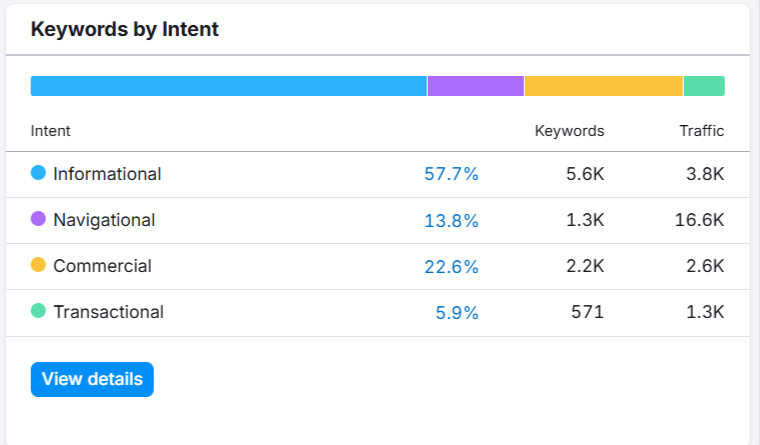
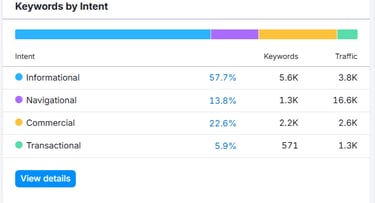
3. They were still focused majorly on SEO rankings versus AI citations. Why does that matter? A huge chunk (57.7%) of Kiavi's ranking keywords were informational keywords. For the majority of informational keywords today, AI Overviews now take center stage.
Only 22.6% of Kiavi’s targeted keywords were commercial intent keywords (BoFu keywords that indicate real customer interest). Commercial keywords often have low search volume. And AI Overviews were eating up a big chunk of traffic from those 57.7% informational keywords. That may explain the stagnant traffic.
To capture those informational searches, Kiavi needed to be visible in AI Overviews, ChatGPT, Claude, basically anywhere people are asking questions — and not just on page one of Google.
Kiavi subsequently hired Agnes A. Gaddis, BoldREcontent's founder — a specialist REI content writer who could create human, deeply-researched content infused with real-estate-insider depth, and optimize it for both traditional SEO and GEO simultaneously.
Setting up
We began by immersing ourselves in their brand: studying their voice, mapping out their core audiences, understanding their main offers, and building a library of applicable CTAs for their offer pages. We started the outlining stage for each article with deep audience research to identify the major audience brackets, desires, pain points, and objections before writing a single word.
Each blog post began with an in-depth review of expert insights on forums like BiggerPockets, Reddit and YouTube (where applicable) to get expert takes before writing. Combining this with my own real estate writing experience meant each article offered depth.
The toolkit
Human long-form content creation (incorporating E-E-A-T quality standards).
Answer Engine Optimization (AEO), focusing on three main things: formatting, entity optimization, and FAQ architecture to improve AI Overviews citations.
Systematic internal linking — strategic link juice distribution and keyword cannibalization management.
Content repurposing — where we take every single blog post and transform it into 12 platform-specific social media pieces for Facebook, Instagram, X, and LinkedIn.
ToFu-to-BoFu content mapping — offered ideation help using our system, where we pair one top-of-funnel article with three bottom-of-funnel ideas and tie them all together with direct linking.
Insight 1: Human-first content
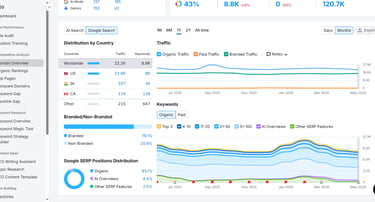
Kiavi hit their highest-traffic month on record in September 2025 — our first month of content delivery. According to Semrush, they recorded 27,945 sessions that month.
Why did the content resonate so well with readers and AI systems right away? It’s because we prioritized human content and E-E-A-T (Experience, Expertise, Authoritativeness, and Trustworthiness) from the start.
What “human-first” actually means
While we use AI in the background, every piece is carefully and completely written or re-written by a human. Although we agreed on 1,300 words per piece with Kiavi, our articles routinely came in at 2,000-2,500 words — not to impress the client, but because our own quality checklist demanded it.
E-E-A-T: Spotlighting real experience
Both Google and AI platforms want to surface or cite articles grounded in real human experience. So most of our articles opened by establishing that experience directly in the intro. By quickly answering: "what qualifies you to speak on this?" or "can I trust you to factually address this topic?", we could garner attention early, build trust, and separate our work from the mass of commodity content.
We believe experience is what makes the difference between commodity content and truly useful content. To infuse that in our work, we pull from applicable sources of real-life experience: forums, videos, real-life situations, interviews. Examples of how we did this in month 1 of our engagement:
E-E-A-T in Action
“After analyzing conversations from 100+ active real estate investors (REIs) on Reddit and BiggerPockets, we found that the following real estate investing resources were the ones most REIs credited for their success.” or
“One Missouri real estate investor shared on Reddit how they converted a 43-bed hotel with zero down payment, creating 42 rooms of affordable housing ($850/month/room) that was instantly leased and now receives 12 calls from potential renters weekly.” This infusion of "experience" contributed to traffic rising to 27,945 in the first month.
The internal linking wins
Our first piece for Kiavi was a "best real estate investing books and podcasts" roundup. We linked this to an existing "best real estate investing books" article. The new piece drove link juice to the existing one, pushing it to #1 on Google for its target keyword. This was the cannibalization fix in practice — both articles working together instead of competing against each other.
The Cannibalization Fix
Our internal linking strategy solved the issue of keyword cannibalization, which is basically when a few different articles end up competing against each other for the same keyword. Here's a fix we found: Using smart internal linking, you can actually have two or three pieces optimized for the same keyword without hurting your rankings for that keyword.
The supporting articles would be made to pass traffic and link equity to the primary article using the primary keyword as an exact-match anchor text. Those supporting articles become levers that help the first rank higher and drive more traffic to it.
Audience research before writing a single word
During the outlining stage, we dove into sites like BiggerPockets, Reddit, and YouTube to see what real estate investors were actually saying. This is also where we identified the major audience brackets for each article, their desires, pain points, and objections (all based on actual research). Answering these "objections" became a major part of our AEO strategy.
Insight 2: AEO optimization (getting picked up by Google's AI)
Great content without AEO optimization doesn't work in 2026. Here's the exact framework we followed to optimize Kiavi's content for AI Overviews:
1. E-E-A-T in the intro
To signal authority, we opened most of our intros with a concrete experience statement. That's because we understood that AI platforms want to cite articles grounded in real experience. But over time, we stepped back from this — which was a mistake.
2. FAQ architecture
We introduced at least four questions towards the end of each article and formatted them as H3 headings for easy discovery by AI search bots. We didn't just make up these questions. We pulled them directly from Google's "People Also Ask" section and from real forum threads on Reddit and BiggerPockets. If real people were asking it, we answered it using a BLUF (bottom-line-up-front) approach — to make it easier for AI systems to extract and surface our answers.
5. Question-format H2s
To increase the probability of citation, we rewrote some H2 headings into question formats that match how investors phrase queries when talking to AI tools. For example, instead of using "Fix-and-Flip Loan Requirements", we switched to "What Are the Requirements for a Fix-and-Flip Loan?"
3. Objection-based sections
We turned the objections earlier identified into specific H2 headings that match the exact questions people type into AI tools. For example, if one of our identified objections was "BRRRR doesn't work in today's market?", one of our sections had to be "Does BRRRR work in today's market?" — because that is the exact query someone types into an AI tool when they have that concern.
While we couldn't always cover all identified objections, we addressed the main ones. Some of the objections we couldn't cover went into the FAQ section. By clearly addressing these objections in a clear, well-structured H2 or H3 section, we turned them into AEO opportunities.
4. Numbers, data, and specific examples
Depth carries weight for AEO. AI answers want to surface real numbers and examples. But depth is even more important for SEO rankings. If people feel your content is too shallow, they'll leave your page immediately, and that tells search engines to drop that page's ranking.
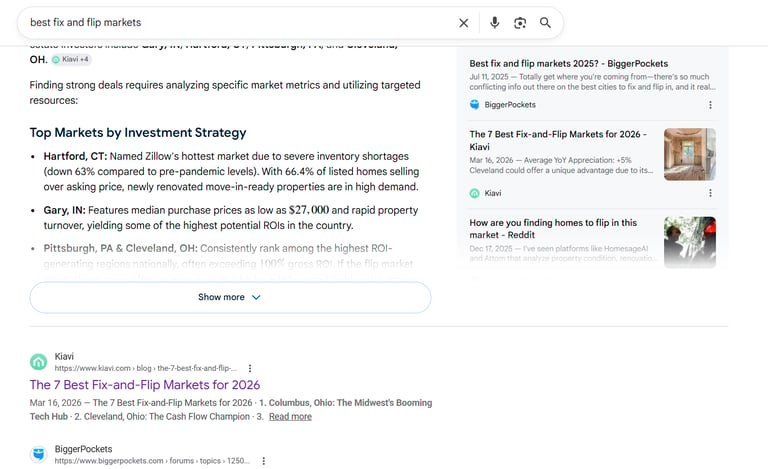
Two of Kiavi’s recent articles that we wrote now rank in the top 3 for keywords like “rental property investing metrics” and “best fix and flip markets” — because they contained factual numbers and examples.
6. TLDR summaries
Towards the end of our engagement, we collaborated with Kiavi to introduce human-written key takeaways at the top of each blog post. AI tools can check these to get a broad view of the theme of each content before digging in. Plus, these also appeal to skimmers who may not have time to read 2,000+ words.
SEO fundamentals (always applied)
Clear formatting and logical hierarchy throughout.
Optimized for at least 5 new keywords per piece.
5 relevant internal links per article, directed by the linking plan.
Insight 3: Traffic diversification through content repurposing
One of the earliest strategic recommendations we made was repurposing each blog post into engaging social content. We turned every single article into 12 different social pieces for distribution across Facebook, Instagram, X, and LinkedIn. This created multiple reinforcing effects:
Branded traffic growth: Social content drove readers back to the site, increasing branded search volume and direct traffic.
Traffic source diversification: Their blog traffic no longer depended solely on Google's changing algorithm.
Increased customer engagement: Platform-native content formats deepened audience relationships across channels.
What Kiavi Already Does Well
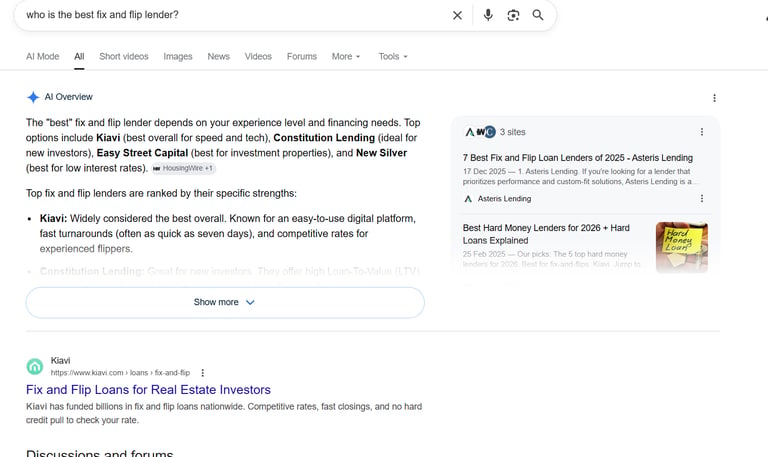
Kiavi had already built strong “surround-sound SEO” by appearing on a number of third-party best fix and flip lender lists. Most of these articles spotlight their speed and efficiency in disbursing loans — making them a leader in both search and AI rankings for queries like “who is the best fix-and-flip lender?”
The results
With human content creation plus AEO and SEO optimization, we were able to achieve the following results for Kiavi within just four months of working together:
YoY AI Overviews Visibility = +1,832.87%
YoY Organic Traffic = +17.4%
Month 1 Traffic (Sep) = 27,945 — all-time high
Social media repurposing workflow = 48 engaging, platform-specific social pieces from 4 blog posts
The Compounding Advantage
Unlike paid ads that stop the second your budget runs out, AI citations and SEO authority continue to build up over time.
Content that earns citation status in AI training data has a high probability of getting cited in related queries. Plus the internal linking architecture ensures that every time new content is published, existing pages get strengthened while the social repurposing engine keeps audience engagement alive between publishing cycles.
Strategic insight for HML firms: The branded search opportunity ahead
For hard money lenders and real estate investing firms, one finding from our analysis deserves special attention:
We found that 79.1% of keywords driving Kiavi's organic search traffic were branded keywords. That is, almost 80% of searchers were using a query that included "Kiavi" by name. Is this a good signal? Yes. It shows brand awareness is already doing the heavy lifting.
The highest leverage next move would be to serve branded content that directly answers people’s questions and objections about Kiavi's platform. These quickly fulfill the intent of people making these branded searches, and drive them directly to offers, as most of these would be high-intent searchers.
The broader lesson for firms in this space is this: trying to get direct conversions straight from cold, informational content is barking up the wrong tree. To actually drive sustainable conversions over time, you ought to prioritize building authority, diversifying your traffic, building trust, and being the brand they see at the eight touch when they are actually looking for a hard money lender.
Still playing the old SERP game?
This combination of human-first content, E-E-A-T, AEO optimization, and strategic internal linking can work for any firm in real estate investment, hard money lending, mortgage origination, or commercial real estate.
Book a discovery call or send an email to agnes@boldrecontent.com. Let’s build a custom content strategy for your brand.

Helping real estate and hard money lending companies grow through expert content and strategic mentions across social media, AI platforms, and industry websites