
Human Writing in the Age of AI: How To Develop a Writing Voice That Doesn’t Sound Like Everyone Else
Learn how to not sound like AI when writing. We cover the importance of your writing voice, what separates human writing from AI, and how to find your voice.
ARTICLE WRITINGAI
Agnes A. Gaddis
12 min read
ARTICLE WRITING, AI
Human Writing in the Age of AI:
How To Develop a Writing Voice
That Doesn’t Sound Like Everyone Else
AI writing feels flat because it sounds like the statistical average of all human writing ever produced.
To find your unique voice, practice these things: imitate your favorite writers, read widely, and write daily.
Stop chasing "not AI." Detection tools and standards are unreliable anyway. You don't need to outrun an algorithm. At the end of the day, the real distinction is between good writing and bad writing. Just bring your voice to the forefront and keep improving as a writer.
Key Takeaways
The world of modern writing is becoming unsettling. Humans are intentionally writing less perfectly to try and prove they aren't machines, while machines are being prompted to write more like humans.
A kind of paranoia has been building up across the writing world since the explosion of ChatGPT. It's now reached the point where brilliant fiction writers are second-guessing their use of em-dashes. Students with formal vocabularies are terrified of being falsely accused of cheating. And marketers keep churning out thousands of words that technically read well but still feel completely lifeless.
I spent some time analyzing forum threads from people trying to make AI-generated content sound human and watching Youtube videos from AI researchers to figure out what separates human writing from robotic output. I found that the special flavor in human writing is "voice".
This guide is for novelists trying to create distinct character dialogue, marketers who want to scale content without losing their brand's soul and silencing their brand's true voice. We've also written this for academics trying to bypass those annoying false AI flags without having to over-simplify or water down their work. We'll cover:
What are the signs of AI writing?
How to develop your own writing voice, and
How to write with AI without sounding like a machine.
Let's get to it.
AI writing doesn't actually sound robotic. It's just "frictionless," meaning everything seems uniform — hedged sentences, similar grammatical structures, words that feel like the most fitting for a specific line of thought, and the majority of sentences having almost equal lengths. This is why AI writing feels a bit off if you're someone who actually writes.
What actually makes writing sound like AI (it's not what you think)
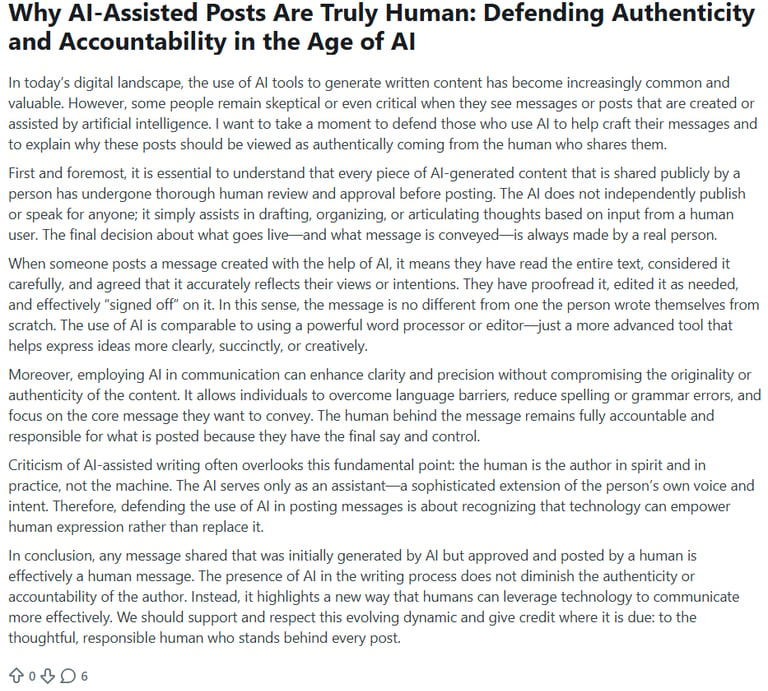
Specifically, here are the common signs of AI writing:
Lists of three (AI almost always lists things in threes)
Paragraph endings that summarize each idea discussed
Academic phrasings ("in conclusion, navigating the digital landscape...")
Flat tone
Mostly surface-level information or content that says a whole bunch of nothing (little to no surprise or new learnings)
Unnecessary passive phrasings (For real estate investors, the takeaway is straightforward:...), and
Bloated words like "delve", "leverage", "moreover", "it is worth noting" that people don't normally use in real life conversations.
There's also the antithesis construction — the "it's not X, it's Y" framing, which AI frequently uses because it thinks it signals confident writing.
Here’s a quick side-by-side comparison of AI and human writing.


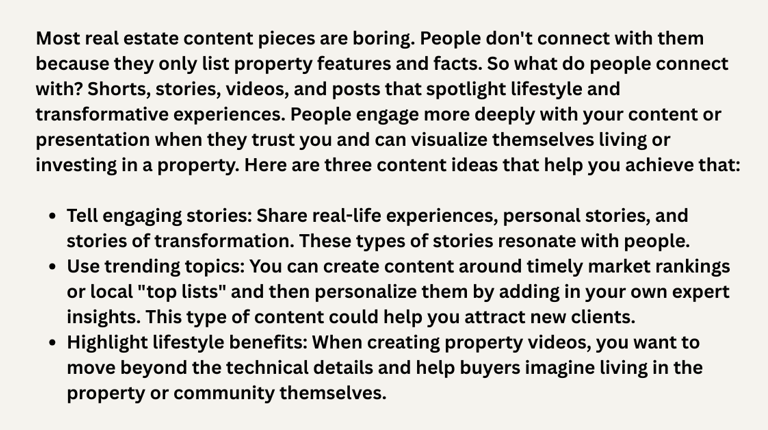
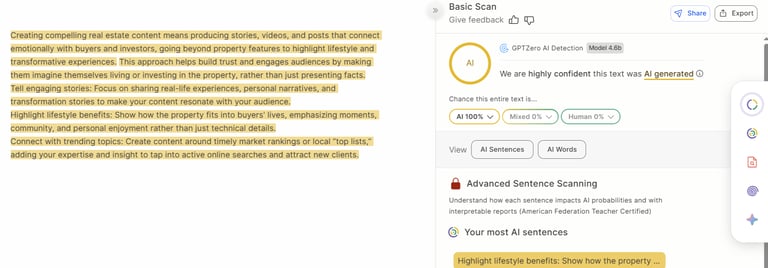
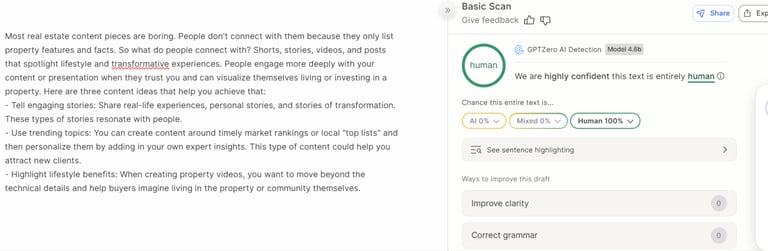
The second version surprises you. That's why you probably read it to the end. And that's the point.
AI writing often feels too stoical compared to how a real person talks. That's because it is created to sound like the mathematical average of all human writing.
This “average sounding voice” is what AI detection models used by platforms like GPTZero detect. GPTZero's model is built around two metrics: Perplexity (how predictable your word choices are), and burstiness (how varied are the length and complexity of your sentences).
AI writing scores low on both. The rhythm is consistent and formulaic throughout. Humans mix it up. We might write a long, dense sentence and follow it up with a short, sparse one. If you are trying to figure out how to not sound like AI when writing, start by eliminating those formulaic constructions.
The issue of voice erosion started long before AI. It's the result of something psychologists call "syntactic priming." This is basically when your brain unconsciously starts mimicking the grammatical structures of the stuff you read most often.
If you spend hours every day reading heavily optimized SEO blog posts, formulaic LinkedIn posts, and heavily hedged corporate newsletters, your brain gets "primed" to produce that same kind of writing. You unconsciously use the same bland rhythm in your own writing. The same hollow enthusiasm from the LinkedIn posts, the hedged sentences, and unnecessary repetitions show up in the things you write.
AI only accelerated the "voice erosion" problem. And yes, it's a major problem right now — even among young students.
Why your voice got flat (and it's not entirely AI's fault)
A peer-reviewed study by researchers at Google and some leading universities found that people who rely heavily on AI wrote essays that answered the happiness question with neutral, non-committal responses 69% more often than those who don't use AI or only use it for minor edits. One of the lead authors of the study described this trend as the "blandification" of writing.
Accepting AI's suggestions without questioning, ruminating on, and editing them trains your writing instincts to prefer blandness. You gradually choose its cadence over yours. Do this enough times and your "editing eye" — that internal voice that catches weak sentences — starts to adjust to the AI's standard instead of your own.
At its core, the difference between good writing and bad writing comes down to intentionality. Bad writing is a symptom of the fact that you aren't making enough deliberate choices in your writing.
So, how do you start making more intentional writing choices? You need to find or re-discover your voice.
Voice is the residue your writing leaves behind in the mind of a reader after the words are gone. Some people describe it as rhythm, others describe it as cadence. But it's the weight your sentences carry when they land in the reader's psyche.
Voice is something you build through practice. It's not something you can force or just flip on like a switch. Any writer who has been told to "just find your voice" and felt nothing but frustration trying the many "writing hacks to find your voice" knows this.
This is also what makes voice the most reliable solution to the “how to not sound like AI when writing” problem. It’s something a model cannot fully replicate. Here's how to build it.
What voice actually is — and how to find yours
Step 1: Imitate intentionally
Imitation through copywork is a historically proven way to internalize rhythm and improve your own writing style. While some writers fear that imitation may make them a copycat, the fact proven throughout history is that the best artists hone their craft through imitation.
Hunter Thompson, considered the father of New Journalism, typed out entire books like "The Great Gatsby" and "A Farewell to Arms" while working at Time Magazine. He used copywork to study how the sentences moved in these books, almost like he was learning music.
You don't have to retype a whole novel. Just pick 2-3 writers whose works you really like, and copy out a section of their work by hand. Pick one writer at a time, and copy out these paragraphs about four or five times.
The next step is to try writing a few paragraphs of your own about something that happened to you. But as you write, try to employ the same style and rhythm as that favorite writer. You can even employ a few wordings they use, wherever applicable. If you don’t get it on the first try, do it again. You can pick another set of paragraphs (or section) from the writer's work(s) and just rinse and repeat.
If you keep at it, you'll start to understand why the best writers make the choices they do, and that's when you really start finding your own voice.
The big risk with this sort of practice is that you might go too deep into one writer's style that your work starts sounding like theirs. This is why you want to mix it up. Copy out works from a variety of authors — contemporary novels, classic novels, solid op-eds, long-form journalism, even poetry — to expand your range.
Step 2: Read widely and deliberately
A fiction writer who only reads fiction ends up with a really narrow range. Marketers who only read blog posts and marketing copy develop an even narrower one. They're stuck in a silo and are limited in creative range. It's why most SAAS blog posts sounded the same, even before AI.
To expand your range, read things like long-form journalism, poetry, history books, classic and contemporary novels. Read any type of writing where the author was able to make deliberate choices about how to express themselves, and made choices that resonate with you. This essentially helps you build up a massive internal library of sentence structures to use in your own writing.
Step 3: Write every day
Emails, texts, and even journal entries all count. The goal of writing every day is to train yourself to be intentional about your writing.
Just like learning musical rhythm with a metronome, you want to use constraints when doing this. You can try an exercise like this: Write a journal entry in 15 minutes where you have to describe a feeling (for example, "tired" or "excited") without using the actual word. Do exercises like this enough times and across enough contexts, and rhythm becomes part of how you naturally write.
AI can't truly capture a writer's unique voice until it's capable of lived experience, specific opinions, and memories of things that change, surprise, annoy, worry, or embarrass a person. Regardless of how thorough your prompts are, you're still going to spend considerable time fine-tuning its output to sound like you.
A researcher recently conducted a test where she asked Microsoft Copilot to summarize qualitative studies about disabled academics. In the summaries, the AI tool swapped the participants’ raw descriptions for polished, institutional-sounding phrases.
Where participants had described being "kicked out" or "left on their own," the AI used phrases like "administrative barriers" and "lack of support." Its descriptions were technically correct, but it had smoothed away the tonality that made the original human writing feel real.
How do I write with AI without sounding like AI?
The manual humanization checklist
Dr Jarek Kriukow, an academic researcher who studies AI detection, explains that AI text fails because it's too uniform. To humanize it, you have to manually break that statistical predictability.
Cut every triplet that isn't necessary
Cut end-of-paragraph summaries
Cut filler words like "leverage," "delve," "moreover," and "it is worth noting."
Cut or completely rewrite any sentence that sounds like it could appear in any article on the subject. For example, in many SEO articles nowadays, you often find something like “SEO isn’t dying, it’s evolving”. That’s AI-speak.
Cut statements that use negative, then positive framing (where possible). For example, “AI is not replacing writers. It’s replacing mediocre writers.” State your point directly.
Vary sentence length. Putting a short sentence right after a long one resets the reader's attention.
Vary paragraph length. Let one paragraph be two sentences. Don't let every paragraph be the same width on the page.
Inject something that AI simply can't add. This could be a real number from your own experience, a specific story or illustration, or a real opinion stated plainly rather than hedged.
Do AI humanizer tools work?
The plain answer is no. For marketers trying to speed up content creation, there is a strong temptation to use automated tools to bypass detection. But it's a bad idea. AI humanizer tools basically ruin your writing. These tools just lower the reading level, force in awkward slang, and even deliberately add bad grammar just to try and trick AI detectors.
The truth is: Even if they manage to fool a detector, they aren't going to fool a human reader — and the human reader is the paying customer. The only way to produce writing that's actually worth reading is manual editing. It's definitely a slower process, but it's the only way to get it done right.
The author could probably have made the prompt more expansive or fed the AI with their past works, but they're still going to get a bland, "no ruffled feathers" summary for such a sensitive topic.
This is what AI does to your drafts too, if you over-rely on it. It smooths away everything that makes your writing feel authentic.
So how should you use AI to write? Let it generate the first draft. Once you have the draft, your job is to decide if it says what you'd like it to say, and then make it sound like a real person wrote it.
The workflow that actually works
As a writer, AI is your scaffolding. Use it for things like outlining, research, or getting a rough draft down. But then before you can publish, you need to do a full rewrite at the sentence or paragraph level. Not a word swap, a full rewrite.
Ask yourself questions like: What do I actually think about this? What's a specific example I can use to drive home the point? What can I cut because it seems unnecessary or excessive?
That last question may be the most important. Because AI doesn't really know how to cut. It can add more words and hedge statements. But you have to be the one to trim the fat.
AI detectors are also unreliable tools. Take Turnitin for example, which is used in some academic institutions. Turnitin has run its AI detector on more than 38 million student essays but now admits that their software incorrectly flags about 4% of human writing at the sentence level. That equates to probably over 1.5 million incorrectly flagged essays.
In a test involving 16 student writing samples, containing real student writing and AI-generated samples, it made mistakes classifying 8 out of the 16 samples and even flagged a completely human-written essay as being partly AI-generated.
Stop trying to not sound like AI. Start trying to sound like you.
You’ll find a lot of advice, tips and tricks online on how to not sound like AI when writing. Just understand that warping your natural voice or introducing grammar errors in order to bypass an unreliable algorithm is plainly bad writing. Since AI was trained on human text, some overlap is inevitable.
For example, some people think the em-dash is a sign of AI writing. But, as The Ringer points out, it's actually one of the most human punctuation marks. That’s because it captures how thoughts interrupt themselves mid-sentence. If you're a writer who naturally uses em-dashes, removing them from your writing basically just flattens your voice.
If you're being accused of sounding like AI because your natural way of thinking involves using formal vocabulary, keep being even more unmistakably you. Don't try to sound less like yourself just to avoid being mistaken for AI. Keep your voice. Be specific, opinionated, and "alive" on the page in ways a machine can't.
Your voice already exists. The real work is noticing it and protecting it.
In part 2, we look at the concept of authenticity and the future of writing with AI. Read it here.
And if you’re looking to turn your AI content pieces into rich and engaging human writing, check out this offer.
Conclusion
Generic writing is. Writing with a specific, opinionated voice might actually be more valuable than ever. We are all exposed to so much AI fluff nowadays, so I believe in the coming years, we are going to ascribe more value to writing that's deeply personal and messy. That kind of writing will stand out like a beacon.
Writing is essentially telepathy. When you write about something you actually felt — like a story about the grief of losing a pet or the gritty, behind-the-scenes details of a failed marketing campaign — the reader feels what you feel. AI can only mimic those emotions, it can't actually feel them.
FAQs
3. How do you develop your own writing voice?
You do it by imitating skilled writers, reading across different genres, and practicing with constraints. These things train your brain to select the rhythmic and stylistic combinations that will eventually form your own linguistic footprint.
4. Is there an AI that makes writing not sound like AI?
The short answer is no. A number of people rely on AI humanizers like Undetectable AI for making AI-generated content sound human. But these tools only perform surface-level word swaps that can make your ideas more confusing. They ruin the quality of your writing. For true human writing, editing should take place at the level of ideas, not just words
2. What makes writing feel like AI?
Statistical predictability. AI generates text by picking the most likely next word based on what came before it. The output may read nice but still almost always feels flat. The signs to look for are monotonous tone, no real point of view, and filler words and phrases like "moreover," "denoting," or "it is important to."
1. Is writing dead in the age of AI?
5. Should I change my natural writing style to avoid sounding like AI?
No. People often overcomplicate how to not sound like AI when writing. If you already write clearly with varied sentence lengths and include your own examples in your work, you're already human. Just keep improving as a writer.
Don't use AI detectors as your benchmark. They are mostly unreliable. In one Stanford University study, AI detectors falsely flagged 61% of essays by non-native English speakers as AI-generated. Just focus on writing better, not proving you're human.
6. Imitating my favorite authors feels like copying. Is there a better way to develop my own writing style?
No. As legendary writing teacher William Zinsser pointed out, "imitation is actually a vital part of the creative process." Even masters like Bach and Picasso used models to learn. However there is a difference between mindless copying and mindful imitation. You don't want to just copy out someone else's ideas.
Your goal is to learn how one sentence flows to the next — the rhythm of their sentences. Over time, you'll shed those skins and find your own voice.

Helping real estate and hard money lending companies grow through expert content and strategic mentions across social media, AI platforms, and industry websites